OAuth-Plan – Step 1B Milestone
Failure & Edge Case Flow Documentation
1️⃣ Purpose of This Document
This document completes Step 1B of the OAuth-Plan.
It describes how the authentication system behaves when things go wrong:
popup issues, Google errors, CSRF problems, missing cookies, expired
sessions, and 401 responses during normal usage.
The goal is to have a clear, stable “resilience spec”:
for each scenario we define:
- How it is detected (frontend + backend)
- How the browser UI reacts
- How the Flask API responds
- What the user sees
- What gets logged for future debugging
Step 1B is documentation-only. It does not necessarily mean everything is
already implemented exactly like this, but it is the target
behaviour specification that later phases will converge to.
2️⃣ Scope: Failure & Edge Case Scenarios
The following scenarios are considered in this milestone:
| ID |
Scenario |
Where It Happens |
Primary Symptom |
| E1 |
Popup closed before login completes |
Browser / Frontend |
Promise rejection: "Popup closed" |
| E2 |
Google OAuth error (redirect_uri mismatch, consent error, etc.) |
Google → Flask callback |
Redirect to error page or JSON error from callback |
| E3 |
CSRF / state mismatch or missing cookie |
Flask callback |
{"error":"csrf_state_mismatch"} or similar |
| E4 |
Session cookie missing/blocked at /auth/me |
Browser / Flask |
/auth/me returns 401, user seen as logged out |
| E5 |
Session lost/expired while user is using the app |
Browser / Flask |
API starts returning 401 mid-session |
| E6 |
BroadcastChannel / popup success notification never received |
Browser |
Main window “waits” and user experiences confusion |
| E7 |
Internal auth exceptions (e.g. parsing id_token, network issues) |
Flask auth backend |
5xx or structured error JSON |
3️⃣ Scenario Specs (Per Error Case)
E1 – Popup Closed Before Login Completes
Frontend UX
- Trigger: User closes the Google login popup manually, or the popup is blocked/closed by the browser before successful OAuth completion.
- Detection (frontend):
loginWithPopup() runs a timer that checks popup.closed. If the popup closes before the auth:success BroadcastChannel message is received, the Promise is rejected with new Error("Popup closed").
- Backend behaviour: No request reaches the callback or token exchange; backend remains unaware.
- UI behaviour:
- Auth badge remains in “Sign in” state.
- An optional non-intrusive message can be shown (toast / log line): “Sign-in was cancelled or the popup was closed.”
- User-facing message (recommended): short info only, no red “error”:
“Sign-in didn’t complete because the popup was closed.”
- Logging:
console.error("Login failed or cancelled:", err) on the frontend.
E2 – Google OAuth Error (redirect_uri mismatch, consent errors, etc.)
Backend UX
- Trigger: Google redirects back with an error, or shows an error page when redirect_uri is not registered or another OAuth configuration problem occurs.
- Detection (backend):
- Flask’s
google_callback sees query parameters error or fails to exchange the code.
- Authlib raises
OAuthError or token exchange fails with HTTP error.
- Backend behaviour:
- Return structured JSON such as:
{"error":"oauth_error","detail":"..."} , or
- Redirect to a future
/auth/error page for better UX (optional improvement).
- Frontend behaviour:
- The popup will typically show the Google error or a minimal error page.
- Main window does not receive
auth:success, so login remains “not authenticated”.
- User-facing message (phase 1B target):
“Sign-in with Google failed due to a configuration or consent error.”
- Logging:
- Backend logs the underlying OAuth error with stack trace.
- Frontend can log that the popup closed without success.
E3 – CSRF / State Mismatch or Missing Cookie
Backend
- Trigger:
- State in callback query does not match state stored in session, or
- No session cookie is present on callback.
- Detection (backend):
request.args.get("state") differs from session["oauth_state_dbg"], or- Session cookie missing (
"session" not in request.cookies).
- Backend behaviour (current):
- Return
{"error":"csrf_state_missing_cookie"} or {"error":"csrf_state_mismatch"} with HTTP 400.
- Frontend behaviour:
- From the user’s point of view, sign-in fails; the popup may show a JSON error or a minimal error page.
- Main window never receives
auth:success and stays unauthenticated.
- User-facing message (future improvement):
“We couldn’t complete sign-in. Please try again. If the problem persists, check that cookies are allowed for rforssen.net.”
- Logging:
- Backend logs reason and state values (without leaking secrets).
- Useful for debugging cookie domain / SameSite issues.
E4 – Session Cookie Missing / Blocked at /auth/me
Frontend Backend
- Trigger:
- Browser privacy settings or extensions block cookies.
- Invalid domain / SameSite configuration.
- First load in a new browser with no session yet.
- Detection:
GET /api/auth/me returns 401 with {"authenticated": false}.
- Backend behaviour:
- Always respond with HTTP 401 +
{"authenticated": false} when no session is present.
- Frontend behaviour:
fetchAuth() treats any non-200 as “not authenticated”.- The auth badge shows a “Sign in” button.
- Protected features that require auth remain unavailable and can show a small lock/tooltip.
- UX text (optional hint):
“You’re not signed in. Sign in with Google to access your content.”
- Logging:
- Frontend:
console.warn("Auth probe error:", e) on fetch failures.
- Backend: minimal logging; this is normal behaviour, not an error.
E5 – Session Lost / Expired While Using the App
Frontend Backend UX
- Trigger:
- Flask process restarts.
- Server-side session storage cleared.
- Session times out (future policy).
- Detection:
- Requests that previously worked (e.g.
/api/video_server/get_directories) suddenly start returning 401.
- Backend behaviour:
- For any protected endpoint, return HTTP 401 with a consistent JSON structure, e.g.:
{"ok": false, "error":"not_authenticated","authenticated": false}
- Frontend behaviour (target):
- Detect 401 in
checkGetDirectoriesAuth() and similar helpers.
- Reset
appState.auth to {authenticated:false}.
- Re-render auth badge to “Sign in” state.
- Show a gentle banner: e.g. “Your session has expired. Please sign in again.”
- Logging:
- Frontend logs “401 during API call, treating as logged out”.
- Backend may log session expiry in debug mode, but not as a hard error.
E6 – BroadcastChannel / Popup Success Not Received
Frontend
- Trigger:
- Browser blocks BroadcastChannel or it behaves inconsistently (older browsers, unusual privacy modes).
- /oauth-popup-complete.html never runs or cannot send the message.
- Detection:
- Popup finishes login and closes, but main window never receives
auth:success.
- User manually reloads main page and
/auth/me now returns authenticated (or not).
- Backend behaviour:
- Unaffected – session is correctly set if OAuth succeeded.
- Frontend behaviour (target):
loginWithPopup() currently depends on BroadcastChannel. Future robustness plan:- After popup closure, optionally perform a
fetchAuth() retry to double-check whether login actually completed.
- User-facing message:
“If the page doesn’t update after login, try reloading.” (optional hint in early phases)
- Logging:
- Frontend:
console.warn("Popup closed but no auth:success broadcast received").
E7 – Internal Auth Exceptions
Backend
- Trigger:
- Network issues towards Google.
- Authlib internal exceptions (e.g. parse_id_token failure).
- Unexpected data from Google.
- Detection:
- Unhandled exceptions inside
google_callback.
- Backend behaviour (current):
- Catch-all block returns
{"error":"internal_error","detail": str(e)} with HTTP 500.
- Frontend behaviour:
- Popup shows error JSON or a basic error page.
- Main window never receives
auth:success.
- User-facing message (future, friendlier page):
“Something went wrong during sign-in. Please try again in a moment.”
- Logging:
- Backend logs full stack trace + context.
4️⃣ Failure-Oriented Sequence Diagram (Mermaid Text)
Generic representation of a failed login attempt (covers E1/E2/E3/E7).
        sequenceDiagram
            participant U as User
            participant B as Browser (Main Window)
            participant P as Popup
            participant API as Flask Auth API
            participant G as Google OAuth

            U->>B: Click "Sign in"
            B->>API: GET /auth/login/google?popup=true
            API-->>G: Redirect to Google OAuth

            G-->>U: Show Google Login Page
            U->>G: Interact (login or cancel)

            alt User closes popup (E1)
                P--xB: <no auth:success>
                B-->>B: Promise reject("Popup closed")
                B-->>U: Stay logged out, show optional message
            else Google / config error (E2)
                G-->>API: Redirect with error
                API-->>P: JSON / error page (oauth_error)
                P--xB: <no auth:success>
                B-->>U: Stay logged out, optional "Sign-in failed" hint
            else CSRF / state mismatch (E3)
                G-->>API: Redirect with invalid/missing state
                API-->>P: 400 {"error":"csrf_state_mismatch"}
                P--xB: <no auth:success>
            else Internal error (E7)
                API->>API: Exception
                API-->>P: 500 {"error":"internal_error"}
                P--xB: <no auth:success>
            end

            Note over B: User remains unauthenticated
auth badge still shows "Sign in"
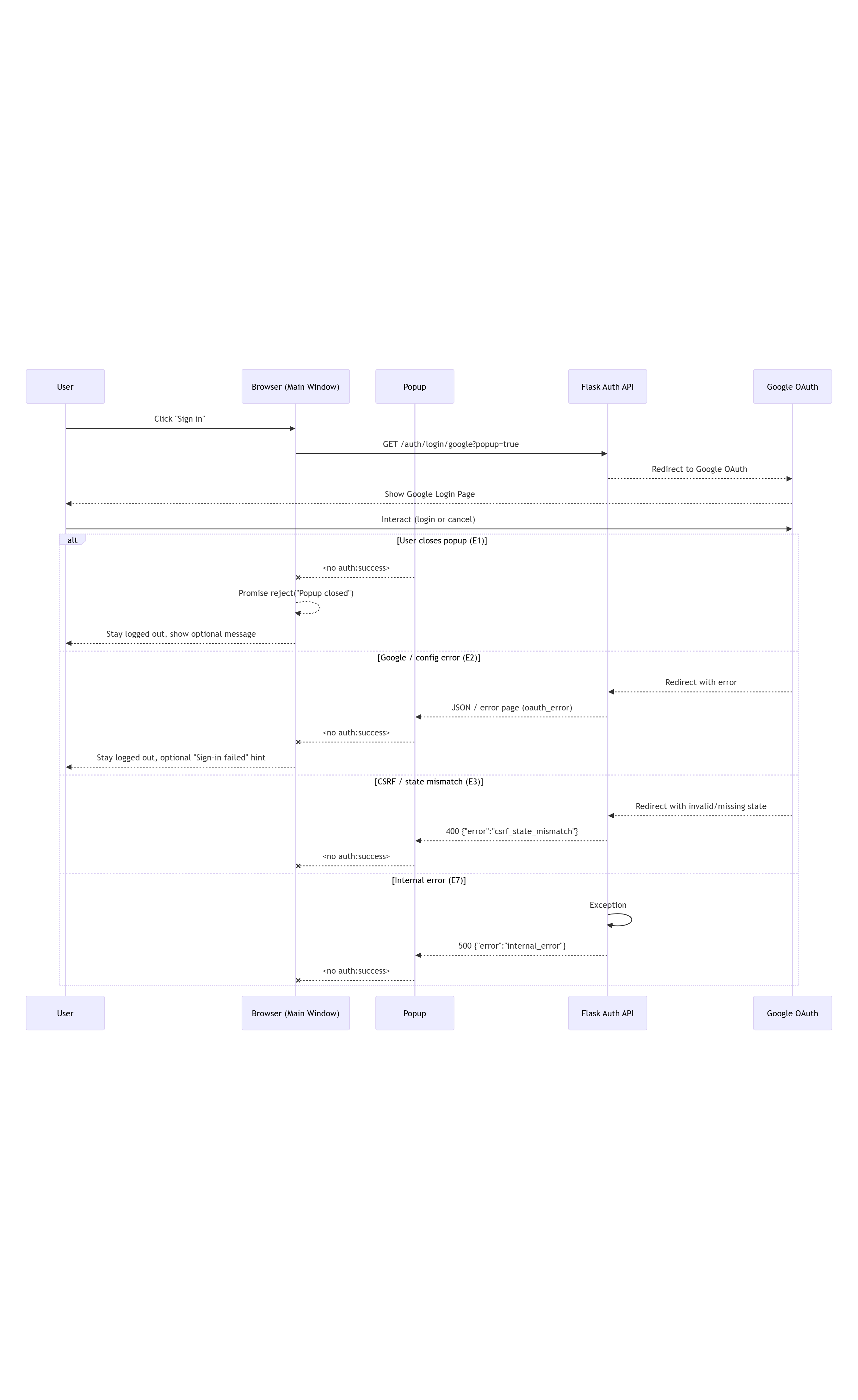
Figure: Failure-Oriented Sequence Diagram
5️⃣ Session Loss & 401 Handling (Mermaid Text)
This diagram shows mid-session expiry (E5) when the user is already inside the app.
    sequenceDiagram
    participant U as User
    participant B as Browser App
    participant API as Flask API

    U->>B: Interacts with app (clicks "Refresh directories")
    B->>API: GET /api/video_server/get_directories (with cookie)
    API-->>B: 200 OK (authenticated)

    Note over B: Time passes, server restarts or session expires

    U->>B: Interacts again (refresh, analyze, etc.)
    B->>API: GET /api/video_server/get_directories (old cookie)
    API-->>B: 401 {"ok":false, "error":"not_authenticated"}

    B-->>B: Treat user as logged out
    B-->>U: Show banner "Session expired, please sign in again"
    B->>API: (optional) GET /auth/me
    API-->>B: 401 {"authenticated":false}

Figure: PlantUML Popup Authentication Flow
6️⃣ PlantUML – Error Flow Variants
Consolidated PlantUML sequence that shows success vs error branches.
        @startuml
        title OAuth Login - Success vs Failure Variants

        actor User
        participant "Browser (Main Window)" as B
        participant "Popup Window" as P
        participant "Flask API" as API
        participant "Google OAuth" as G

        User -> B: Click "Sign in"
        B -> API: GET /auth/login/google?popup=true
        API -> G: Redirect to Google OAuth
        G -> User: Login / Consent Screen

        alt SUCCESS
        User -> G: Accept / login
        G -> API: Redirect with code
        API -> G: Exchange code -> token
        G -> API: Token + user info
        API -> API: Store session
        API -> P: Redirect /oauth-popup-complete.html
        P -> B: Broadcast auth:success
        B -> API: GET /auth/me
        API -> B: 200 authenticated
        B -> User: UI shows "Signed in"
        else POPUP CLOSED (E1)
        User -> P: Close window
        P -x B: <no auth:success>
        B -> B: Promise reject("Popup closed")
        B -> User: Stay logged out, optional info
        else OAUTH ERROR (E2)
        G -> API: Redirect with error
        API -> P: Show {"error":"oauth_error"}
        P -x B: <no auth:success>
        B -> User: "Sign-in failed"
        else CSRF / STATE MISMATCH (E3)
        G -> API: Redirect with invalid state
        API -> P: 400 {"error":"csrf_state_mismatch"}
        P -x B: <no auth:success>
        else INTERNAL ERROR (E7)
        API -> API: Exception
        API -> P: 500 {"error":"internal_error"}
        P -x B: <no auth:success>
        end

        @enduml
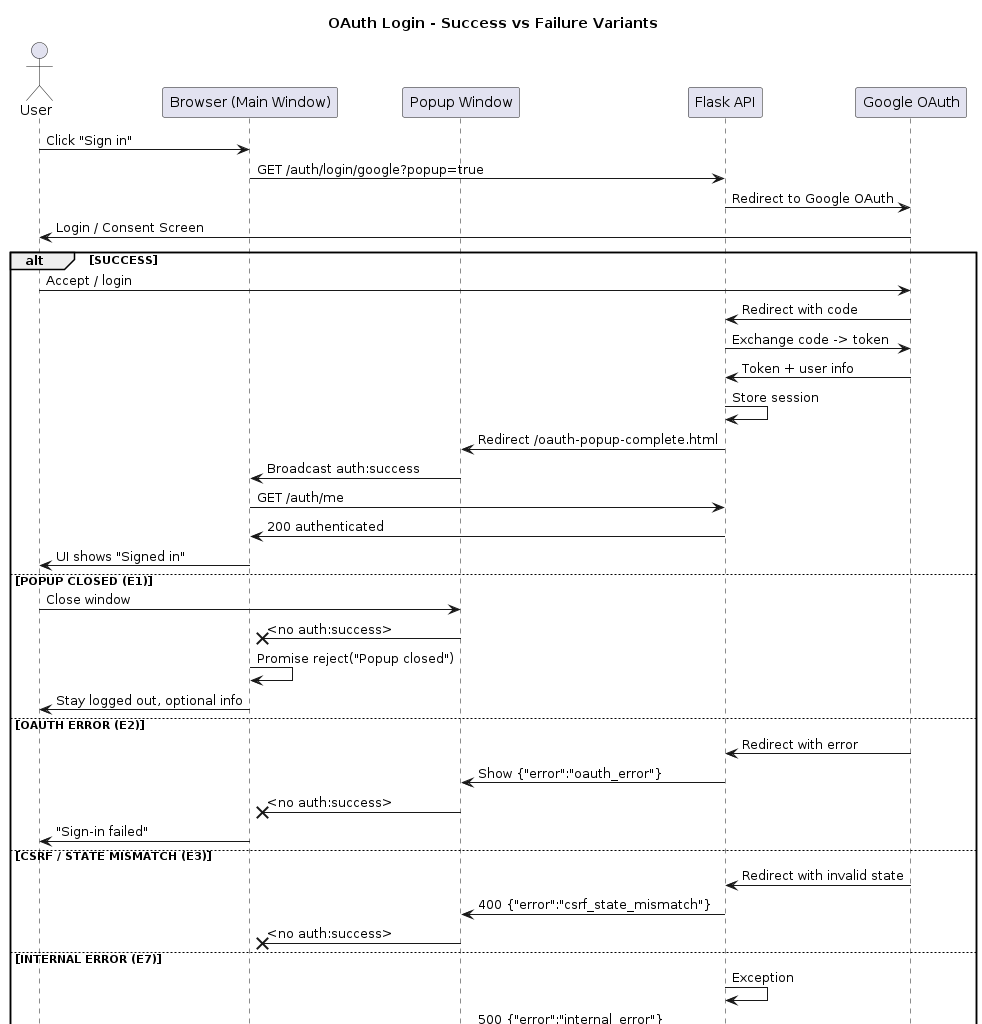
Figure: OAuth Login - Success vs Failure Variants
7️⃣ Behaviour Invariants
To keep behaviour predictable and easy to reason about, the following
invariants are defined:
- Invariant 1:
/api/auth/me is the single source of truth for “is the user authenticated?”.
- Invariant 2: Any protected API endpoint that sees no valid session returns HTTP 401 with a stable JSON schema (e.g.
{"ok": false, "error": "not_authenticated"}).
- Invariant 3: The frontend never tries to guess auth state; it always bases it on
fetchAuth() or API responses.
- Invariant 4: Popup success is signalled via BroadcastChannel, but the system should tolerate the broadcast failing (future robustness: retry
/auth/me upon popup close).
- Invariant 5: CSRF/state-related errors are treated as hard failures: user must re-initiate login.
8️⃣ Milestone Status
Step 1B of the OAuth-Plan is now documented.
All major failure and edge-case flows have:
- A named scenario ID (E1–E7)
- Defined detection behaviour
- Defined backend and frontend responses
- Mermaid and PlantUML representations for future diagrams
Implementation can now be aligned with this spec, and deviations can be
treated as bugs or future design changes.
Next milestone: Step 1C – Environment Split & Redirect-URI / Config Strategy.